Choosing books for kids often begins with the age on the cover, but age is only a starting point. Two five-year-olds may enjoy different pacing, humor and amounts of text. With picture books, also consider what the artwork tells you and what invites a child to linger on a page.
The aim is to find a book that fits your shared reading. A few questions, a real page preview and a choice for the child can help.
What does the child enjoy discovering?
Start with something that currently interests the child: friends, vehicles, a journey, an animal or a problem to solve. An interest gives you a way into a story; it need not limit every book you choose.
Look at the cover together and ask what might be happening. There is no need to guess correctly. Notice whether the picture raises a question the child wants answered.
Do the illustrations add to the story?
Open an inside page and look for what a character wants, where they are going and what has changed. A picture may reveal something the words do not state: a friend's expression, a small object or a route nobody has noticed yet.
Consider whether the artwork is clear on your reading device or when you hold the book for two children. A genuine page preview is more useful than a general promise of beautiful illustrations.
Does the language work when read aloud?
Read one page aloud. Are the sentences comfortable to speak? Is there room for the child to look and respond? A short book is not always simple, and more text does not automatically mean a better fit for an older child.
A preschool child may want to stay with one picture or read only part of the book. A child who is starting to read can choose a sentence, follow along or simply listen. Shared reading does not have to become a test.
How does the story handle friendship and difference?
In children's books about friendship, look for characters who have wishes and choices rather than serving only to deliver a lesson. Who offers an idea? Who listens? Can someone say that a proposed solution does not work for them?
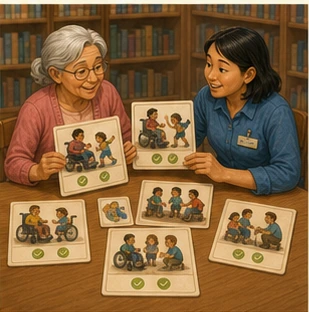
When disability is represented, notice whether the character participates in the plot and the group. A mobility device need not be the whole story, and a friend need not do everything on another character's behalf.
Choose respectful disability representation in picture books
Check the edition before you choose
Check the language, format, page count and available sample. Print and Kindle can present illustrations differently. Different editions may also include different wording or additional discussion material.
Willy's site presents the current English picture book with edition details and a preview. This is the series' own website, so the information helps you assess that book; it is not an independent ranking of children's books.
Frequently asked questions
Are picture books suitable for children who already read?
Yes. Children can read alone or together and explore what the pictures add, according to their interest and comfort.
Should I choose only by the recommended age?
Age is a useful starting point. Also consider interest, pace, language and a chance to see the pages.
Which detail in the picture made you want to hear the story?