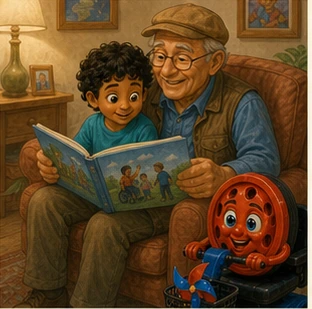
Reading books to children does not require speaking every sentence without a pause. A child may follow a character in the artwork, point to a detail, ask to turn back or listen quietly. All of these can be part of reading together.
This guide offers a simple approach for preschool and early elementary ages. You do not need to prepare a lesson or check what a child remembers. Start with a book you can both see comfortably.
Before reading: leave room for one small choice
Offer a choice of two books or two places to sit. Hold the book so the child can see the pictures. On a screen, enlarge the page until the characters are easy to see.
Look at the cover and describe something you notice. Instead of explaining the lesson in advance, ask what the child would like to discover. You can also begin without a question, especially when they are already asking to hear the story.
During reading: not every page needs a question
Read a few sentences and leave a moment to look. If the child points, you can pause and follow their interest: did you spot something beside the path? If they are listening to the whole story, there is no need to interrupt simply to check that they are following.
Choose one pause before a character makes a decision. Ask what the character wants and what might happen next. Accept several possibilities, or continue without an answer.
Let the pictures tell part of the story
Try telling a small part using only the illustration. The child can choose who is speaking, show where the destination is or point out something that changed. Add only the information needed to carry on.
If the child's idea differs from the text, ask what in the picture suggested it. This creates a conversation about details without treating every response as something to correct.
When a child wants to stop
You can pause, revisit a requested page or return to a familiar book. Finishing in one sitting is optional. Say where you stopped and leave a bookmark if you want to return.
A child who wants to make something can move to a related activity: choose a color for a character, build a toy route or draw a place from the story. The activity is another way to explore the story, rather than a reward for sitting still.
After reading: one question is enough
Ask which moment the child would like to see again, which character interests them or what they would change about the route. There is no need to extract a single correct message. Sometimes they will simply want the same book again.
Leave room for a response without words: a drawing, a pointing finger, a chosen page or a toy moved along a path. Next time, you can begin with that detail.
Frequently asked questions
Should I ask questions on every page?
No. Keep the story moving and pause when a detail or decision invites real interest.
What if a child asks for the same book again?
Read it again. They can choose another detail to notice or simply enjoy the familiar story.
Which page would you like to stay with a little longer?