
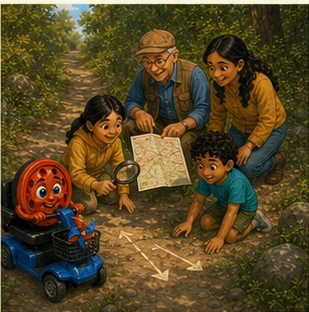
Every adventure starts with something we want to do. Before offering a solution, give the child room to name a goal, offer an idea and choose a step. These questions and activities connect Willy’s active role in his adventure with the small decisions children make in everyday life.
An outing begins before anyone leaves home. “It should be fine” may sound reassuring, but it does not describe the parking, entrance, surface, slope, restroom, turning space, or what rain did to yesterday's path.
Route Detective turns planning into a shared family job. Children gather clues, the person using the route decides what matters, and the family keeps a joyful alternative ready without treating it as second best.
Collect facts, not labels
A place may call itself accessible while offering little detail. Ask for recent photos and concrete descriptions: firm or loose surface, step-free entrance, narrowest point, steepest section, rest areas, and whether conditions change after weather.
Teach children the difference between fact and opinion. “There is a four-inch step” is useful. “It is easy” depends on the person.
Ask the route user
Share the information with the family member who will use the path. They may spot an issue others missed, know their device's turning needs, or prefer a route that looks longer on the map.
Planning with a person is different from planning for them. The checklist supports their decision; it does not replace it.
Prepare a real Plan B
Keep the heart of the outing. If the lookout trail is closed, perhaps a step-free garden still offers the picnic, wind, and time with friends. A backup should feel like another good route, not a consolation prize.
After the outing, note what matched the information and what did not. A calm, factual update can help the venue and the next family plan more confidently.
Which single fact would remove the biggest uncertainty from this outing?