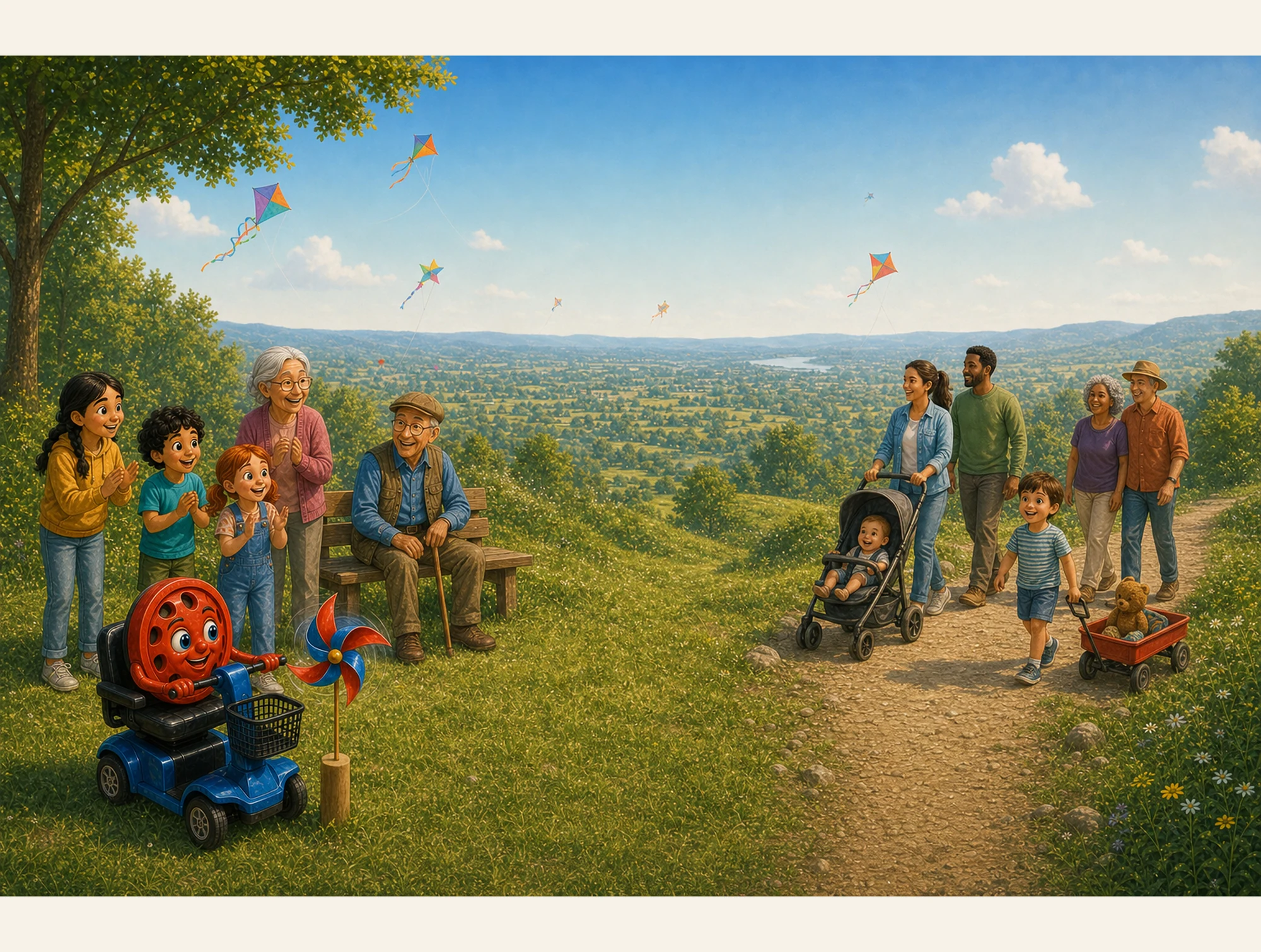
Thinking games for kids can begin with a small question in a story. Willy wants to join his friends, but the trail presents a problem. What should they check? Who knows which route works for Willy? What could they try next? Children can explore these questions through pictures, conversation and play.
For ages 4-8, adjust the task to the child rather than treating age as a test. One child might point to a clue. Another might explain a choice or invent a third possibility. A child who needs help reading can still have a thoughtful idea about the problem.
Give a choice enough time to become an idea
Willy’s picture game contains three short decisions: choose a usable route, ask before helping and test a shared solution. Each scene has a spoken question and two written choices. Feedback explains the decision before the child tries again or moves on.
Before a click, ask, “What do you notice in the picture?” A pointed finger can be an explanation. Give the child time to show the clue instead of supplying the answer. Read the choices aloud together when needed, using the same neutral tone for both.
From an adventure to a decision of their own
Adventure stories begin with a wish: to reach a place, meet friends, play or discover. Before discussing a solution, let the child notice what Willy wants. Then ask, “What would you like to try yourself?” A small connection between the story and a personal wish gives the child a way to lead the activity.
Invite the child to choose between the game, coloring and looking inside the book. These are real decisions with visible results. If they change their mind, let them explain or simply choose again.
Change the path and keep Willy in the decision
In Willy the Wheel and the Winding Path, the adventure leads toward a shared Wind Festival. The useful question is how the surroundings can support participation. Willy has preferences and knowledge about his own route. Friends can ask, listen and try an idea with him.
Make two paper paths to a drawing of a festival. Put a block on one path and invite the child to suggest a change. Test the route with a toy, then describe what happened. This is a model for exploring a design problem, not an attempt to simulate someone’s disability.
Use coloring to try out a plan
Choose Willy and friends or the English book cover. Ask the child whether they want to start with a particular detail or use two repeating colors. The coloring tool fills a whole region with one click, leaving room to focus on color choices without tracing every edge.
After a few clicks, ask whether the child wants to keep the plan or change it. Undo makes a choice reversible. There is no requirement to copy the published cover’s colors. Save or print the finished artwork and invite the child to explain one decision to someone else.
Keep the challenge small and flexible
Begin with one scene and no timer. Let the narration finish before offering another instruction. A child can answer by speaking or pointing, and stopping after one decision is fine. The next session can begin with the same familiar question.
To add a little challenge, ask, “What else might work?” To reduce it, point out two details without choosing an answer. Avoid comparing children’s speed or stars. Their explanations and questions are more useful starting points for the next conversation.
Practice opportunities, with clear limits
Harvard’s Center on the Developing Child describes age appropriate games and activities for practicing executive function and self regulation. Our Willy activities are suggested applications of that broad approach. The site’s game has not been evaluated as a developmental intervention, and we do not claim a measured improvement in a particular skill.
You can still notice concrete actions: a child explains a choice, asks to hear a question again, changes a plan or suggests a test. Treat these as openings for conversation, not as a score or an assessment.
Frequently asked questions
Does my child need to read independently?
The game reads questions aloud after Start, with a replay option. An adult can help read the written choices when needed.
Is Willy’s game proven to improve thinking skills?
No study has evaluated this game’s effects. It offers opportunities to choose, explain and test ideas without promising a measured developmental benefit.
What could we check to find out whether our idea works?